BITMINISTRY / Software · AI · Connected hardwareContact
← All projects

Custom engineering service / Applied AI & production engineering

Make one visual production check measurable, traceable and reviewable.

For one product family and one visible criterion, we engineer the imaging setup, inspection pipeline, evidence record and operator-review workflow, then validate performance against customer-approved decisions.

Discovery, pilot and staged implementation

AI production inspection
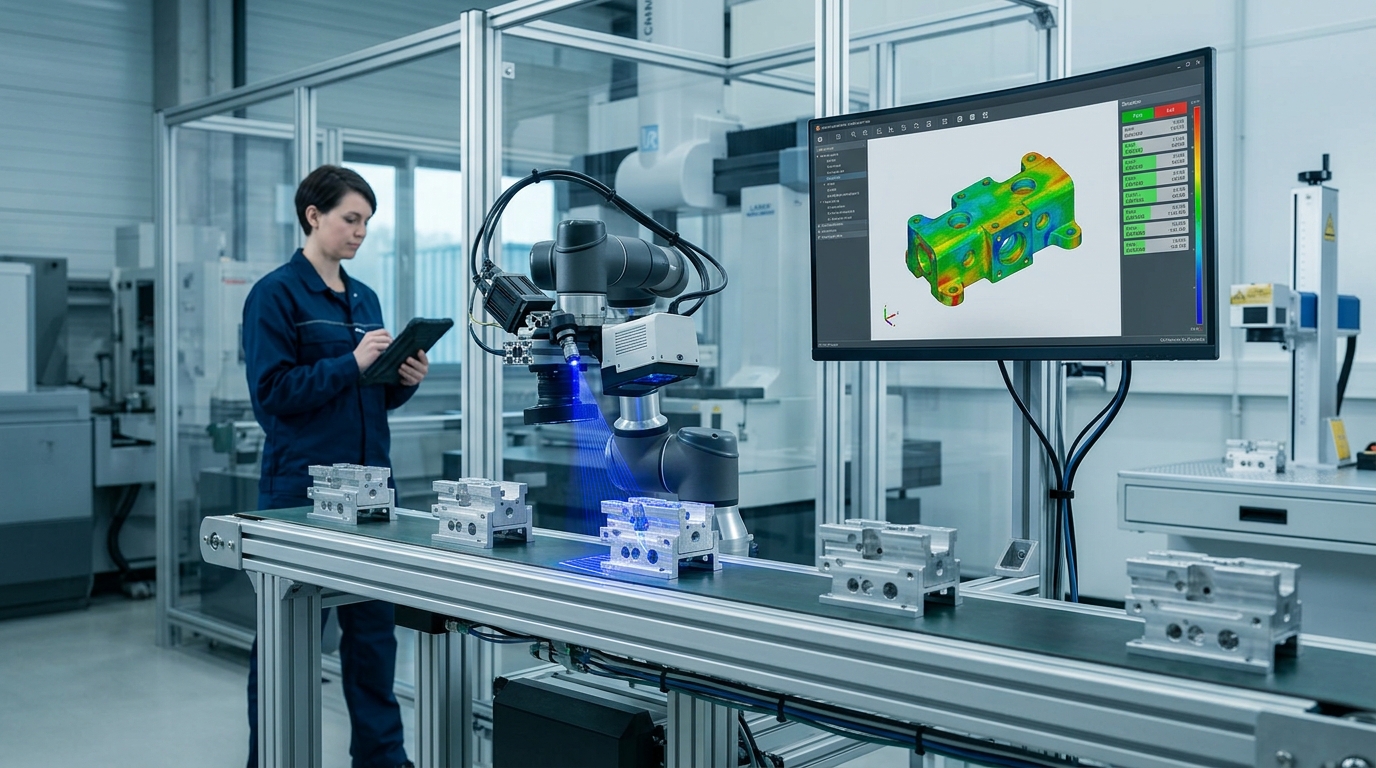
A camera-based inspection station with traceable evidence and human quality review.

01 / The challenge

AI production inspection

A model cannot compensate for undefined acceptance criteria, unsuitable lighting, poor product presentation or missing examples. The visible condition, line speed, variants and cost of missed defects versus false rejects must be made explicit.

The engineering approach

Discovery covers lighting, optics, camera position, triggering and representative data. Suitable computer-vision methods, AI models and explicit rules are combined in a versioned pipeline. Every result retains its image, product or batch identity, inspection configuration and review outcome.

02 / Customer benefit

Customer benefit

  • 01Support consistent execution of one agreed visual check
  • 02Give quality staff evidence for reviewing suspected defects
  • 03Connect observations to products, batches and production orders
  • 04Investigate recurring visible defect patterns in operational context
  • 05Add product variants and inspection checks through a measured process

Good fit when

Good fit when

  • Products have a repeatable visible quality or assembly check
  • Labels, packaging, component presence or surfaces are inspected
  • Conforming and defective examples can be collected and labelled
  • The inspection point, cycle time and acceptance owner are defined
  • Production records expose the identifiers needed for traceability

03 / Published examples with measured outcomes

Published examples with measured outcomes

Independent context from named third-party deployments. These are not BitMinistry projects or promises of equivalent results.

01Seagate

AI image analysis for final inspection of hard-drive slider components across 34 machines.

USD 2.6 million reported saving and outgoing defects reduced from 243 to 153 ppm.

The saving period and full investment cost were not published, so this is not presented as annual net saving.

Read primary source ↗
02Procter & Gamble / Siemens

Visual inspection of variable consumer products on high-speed production lines.

10–20% lower scrap rate depending on product; new deployments reported as 5–10 times faster to commission.

The percentage is relative scrap reduction, not total production-cost reduction or percentage points.

Read primary source ↗
03MSD / Merck & Co.

Analysis of false rejects from existing automated visual-inspection systems across pharmaceutical lines.

False-reject rate reduced by 50% on multiple production lines.

The result concerns false rejects, not total scrap, relaxed quality requirements or total production cost.

Read primary source ↗
04Siemens Amberg

Process-data prediction of which circuit boards require additional X-ray inspection.

Up to 30% fewer X-ray inspections and an approximately EUR 500,000 equipment purchase avoided.

A related selective-inspection example, not a camera detecting hidden solder joints; avoided capital is not annual net saving.

Read primary source ↗

Published savings describe the named deployment and the period or comparison stated by its source. They do not include a complete cost model unless explicitly noted; a BitMinistry pilot establishes the applicable baseline, error tolerance and economic result for the customer's own workflow.

04 / Delivery workflow

Pilot delivery path

Discovery covers lighting, optics, camera position, triggering and representative data. Suitable computer-vision methods, AI models and explicit rules are combined in a versioned pipeline. Every result retains its image, product or batch identity, inspection configuration and review outcome.

01

Specify one visible criterion

02

Engineer imaging and reference data

03

Build inspection and review workflow

04

Validate misses, false rejects and cycle time

Initial pilot deliverables

  • Inspection specification and imaging feasibility assessment
  • A labelled reference dataset with separate validation examples
  • A prototype pipeline and operator review interface
  • Versioned evidence linked to product or batch identifiers
  • A validation report and staged implementation recommendation

Contact

Working on a similar challenge?

Tell us about the workflow, the constraints and the result you need.

Discuss your project ↗